
Survey Companies Near Me for School Campus Expansion Projects
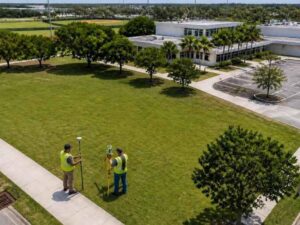
A school campus does a lot at once. It holds classrooms, fields, parking, walkways, and pipes on one piece of land. Any new project has to fit around all of it. Searching survey companies is a smart first step. But a campus needs a firm that gets the scope right before design starts. The survey is the base map the whole project sits on. Pick the wrong scope, and you get redesigns, permit delays, and extra costs once crews show up. This guide covers what the surveyor needs to know, the features to map, the elevation data, the boundaries, and how to pick the right firm.
What Survey Companies Need to Know About a Campus Expansion
A survey company needs to know two things first. What is already on the campus, and what the new work will add. A campus is not a blank lot. It comes with buildings, walkways, fields, parking, pipes, and open land.
The surveyor uses that picture to size the job. A new classroom wing needs different data than a new parking lot. So the firm needs to hear the plan early. It also needs to know what the architects and engineers expect to get. The file format matters too. A design team works in CAD, so the survey has to drop right into their files. Give the surveyor the full story up front, so the survey scope can match the campus project instead of being too broad or too thin. Then the scope comes back right, not padded.
Site Features That Matter Before Adding New Campus Space
New space has to work with what is already there. So the survey maps the current features first. The new part connects to the old campus at many points. Each of those points has to be measured, not guessed.
The list on campus is long. Buildings, drives, walkways, and fences all get mapped. Fields, courts, bleachers, and light poles matter for space and access. Pipes, drains, and parking counts shape what the new work can do. Big trees and open land get mapped too, since they affect where a building can go. When design starts from real spots, the new space fits the campus better. That means fewer changes later.
Pipes deserve extra care on a campus. Old sites often have water, sewer, power, and data lines. Many were added or moved over the years. A surface survey shows what sits on top. Utility locating finds the buried lines a design has to miss. Knowing where those lines run keeps a new footing off a main.
Elevation Data for New Buildings, Walkways, and Drainage
Elevation data shows the grades that are already there. That helps the team design buildings, walkways, and drainage that work. A campus moves a lot of people and water each day. Change one part, and you change how both move.
A topographic survey maps the high and low points across the site. It shows how the land slopes and where water goes now. It sets the tie-in height for a new building. It also sets the grades for the walkways around it. Ramps and paths have to stay under set slope limits. So the survey has to be exact enough to design against. Stormwater planning needs this data too. New roofs and pavement send more water somewhere. Good grades up front keep a walkway from flooding or a door from ponding.
Property Boundaries Around an Expanding School Campus
A boundary survey confirms the campus lines and easements. This matters most when new work moves toward the edge of the land. A big campus can sit on several parcels joined over the years. The real lines are not always where the fences or fields suggest.
Boundaries get tricky near the edges. The campus may share access with a neighbor or a road. That access often runs through a recorded easement. Utility easements can cross the land and limit where a building goes. Setbacks control how close new space can sit to a line. When new work reaches a boundary, check the lines first. That keeps the project from crossing a line or hitting a permit snag. It also protects the school from a fight with a neighbor down the road. Moving a plan a few feet on paper is cheap. Moving a building later is not.
Choosing Survey Companies Near Me for the Project Scope
Compare survey companies near me on a few clear points. Ask about campus experience, the scope, the deliverables, the schedule, and how they will work with your team. Not every firm has worked on a busy, open site. The right questions sort the fit from the rest fast.
Start with experience on jobs like yours. A campus has moving parts a simple lot does not. Check that the scope matches what your architects and engineers need. Ask what the deliverables look like. That could be CAD files, a point cloud, or a signed and sealed drawing. Make sure the schedule fits your project phases. A late survey stalls everything after it. Ask how the crew works around an open campus with students and staff on site. Check that the firm is licensed in your state. A firm that answers these clearly is one you can build a project around.
Frequently Asked Questions
What type of survey does a school campus expansion need?
Most campus projects need more than one survey. They usually start with a boundary survey and a topographic survey. The boundary work confirms the lines and easements. The topographic survey maps the grades and the features on site. Bigger projects may also need utility locating or an ALTA survey if a lender or title review is involved. A good survey company will suggest the right mix after seeing your plans.
How do survey companies work around an occupied, active campus?
Good firms plan their fieldwork around busy times and high-traffic spots. Crews check in with campus staff and follow the site rules. Many also meet background-check rules for working where students are present. They plan access so the work does not disrupt classes, drop-off, or events. Asking a firm how they handle an open campus is a good way to judge fit.
When should we hire a survey company for a campus project?
Hire one early, before the design gets far. An early survey lets the architects and engineers work from real data, not guesses. It also leaves time to fix a boundary or easement issue before it delays the job. Waiting until design is underway often means redraws and lost time. Earlier is almost always cheaper.
For a free land surveying quote, call us at (561) 220-7505 or send us a message by going here.
Posted in land surveying, land surveyor | Tagged Land Surveying